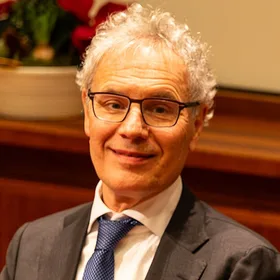
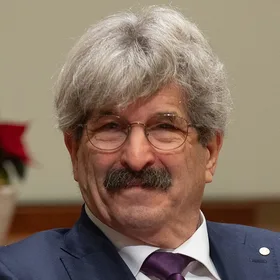
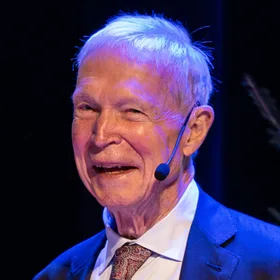
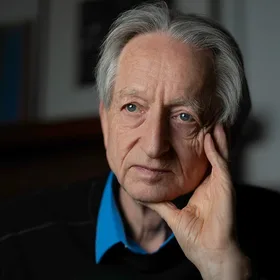
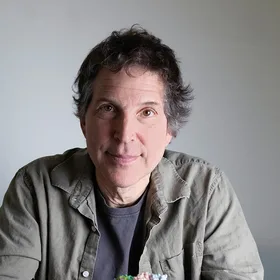
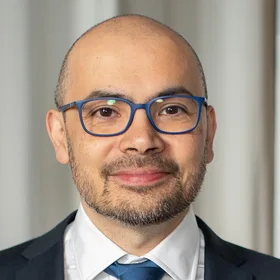
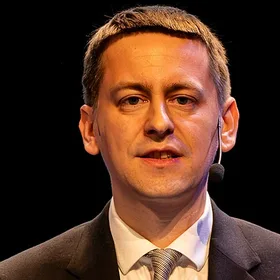
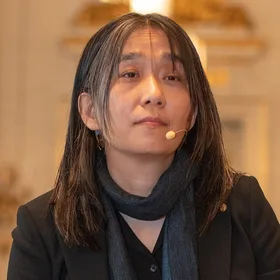
Victor Ambros, Gary Ruvkun · Shared by two people · 31 year wait
What they did
Working with a tiny worm, Ambros found a very small RNA, now called microRNA. Ruvkun showed how it blocks a gene's message. Later he found one that people have too.
Why it matters
Humans have over a thousand microRNA genes. They help build the body, and when they go wrong it can lead to cancer and other illness.
The official reason
"for the discovery of microRNA and its role in post-transcriptional gene regulation"
The long road
31years from their 1993 papers (1993) to the prize
1993Ambros and Ruvkun publish the first microRNA, side by side.
2000Ruvkun finds a microRNA shared by worms, flies and people.
Same genes, different cells.Every cell has the same genes. Yet muscle and nerve cells are very different. Each cell must switch on the right ones.
A worm's clock goes wrong.Ambros and Ruvkun studied a worm 1 mm long. With its lin-4 gene broken, it repeated young steps. Lin-4 held back a gene called lin-14. But how?
A gene that makes no protein.Ambros found that lin-4 makes no protein at all. It makes a tiny RNA, just 22 letters long.
A match in the tail.Ruvkun found the key spot was in the tail of lin-14's message. Lin-4's tiny RNA matches it, sticks there, and stops the protein. Today we call it microRNA.
Not just worms.At first, few cared. It seemed a worm oddity. Then in 2000 Ruvkun found a second one, let-7. Flies and people have it too.
Over a thousand switches.People have over a thousand microRNA genes. One can tune many genes. When they go wrong, it can lead to illness like cancer.
1 · The puzzle
Same genes, different cells.
Every cell has the same genes. Yet muscle and nerve cells are very different. Each cell must switch on the right ones.
A white model made to show the idea. Real RNA is far too small to see, and the worm, the fly and the person are not to scale.
John J. Hopfield, Geoffrey Hinton · Shared by two people · 42 year wait
What they did
Hopfield built a network that can store patterns and bring them back, like a memory. Hinton built on it with the Boltzmann machine, which learns patterns from examples.
Why it matters
Their work led to today's AI. Hinton has also warned about the dangers of AI.
The official reason
"for foundational discoveries and inventions that enable machine learning with artificial neural networks"
The long road
42years from the Hopfield network (1982) to the prize
1982Hopfield describes his memory network.
1985Hinton and colleagues describe the Boltzmann machine.
2012Hinton's students win a big image contest with a neural network.
No recipe for a cat.Most programs follow a recipe, step by step. But no recipe can say what a cat looks like. Brains learn from examples. Their links grow stronger when used together.
A web that remembers.Hopfield built a web of nodes, each linked to every other. Each node is a pixel, dark or light. He set the links so a saved picture has the lowest energy.
Like a ball rolling downhill.Show it a smudged copy. One by one, nodes flip if that lowers the energy. Like a ball rolling into a valley, it ends on the saved picture.
A machine that learns.Hinton and Terrence Sejnowski added hidden nodes and an equation from physicist Ludwig Boltzmann. Shown examples, their machine learned what they share. It could even make new ones.
From 500 numbers to a trillion.Their work helped lay the base for today's AI. Hopfield's 1982 web had 30 nodes and fewer than 500 numbers to tune. Today's big language models can have over a trillion.
1 · The puzzle
No recipe for a cat.
Most programs follow a recipe, step by step. But no recipe can say what a cat looks like. Brains learn from examples. Their links grow stronger when used together.
A low-poly model made to show the idea. Hopfield's first network had 30 nodes; the other webs here are smaller, and real pictures need far more pixels.
Proteins are tiny machines.They do almost all the work in our bodies. Each one starts as a chain of small building blocks, like beads on a string.
The chain folds up.It folds by itself into a 3D shape. The shape decides the job: carry oxygen, fight germs, move muscles.
A 50-year puzzle.Can you tell the shape from the chain alone? Scientists tried for 50 years. In the lab, finding one shape could take years.
AI cracks the puzzle.In 2020, Hassabis and Jumper's AI, AlphaFold 2, predicted shapes from the chain alone. It has now predicted nearly all 200 million known proteins.
Baker works backward.He starts with a new shape, then finds a chain that folds into it. In 2003, his team made a protein not found in nature.
New shapes, new tools.Knowing and designing shapes helps make new medicines, vaccines and tiny sensors.
1 · Proteins
Proteins are tiny machines.
They do almost all the work in our bodies. Each one starts as a chain of small building blocks, like beads on a string.
A cartoon made to show the idea. Real proteins have hundreds of building blocks, of 20 kinds.
A poet first.Han Kang was born in Gwangju, South Korea, and moved to Seoul at nine. Her father is a novelist. In 1993 she began as a poet, then turned to stories.
One woman says no.A woman, Yeong-hye, stops eating meat. Her husband and father try to force her back. She sinks deeper into a world of plants. In 2016 the book won the International Booker Prize.
Her home town's wound.In 1980, soldiers killed hundreds of students and unarmed people in Gwangju. In Human Acts, the souls of the dead leave their bodies and look on.
Pain that does not fade.In the late 1940s, tens of thousands of people were shot on Jeju Island. In this book, two friends still carry that grief, long after, and try to bring it to light.
Body and soul, the living and the dead.Han Kang is the first South Korean writer to win. Her books face hard history and show how fragile human life is.
1 · Gwangju, 1970
A poet first.
Han Kang was born in Gwangju, South Korea, and moved to Seoul at nine. Her father is a novelist. In 1993 she began as a poet, then turned to stories.
A toy theater made to show the idea. The map is simplified, and the pictures stand in for scenes from her books.
Survivors of Hiroshima and Nagasaki, warning the world.
Nihon Hidankyo · One winner · 68 year wait
What they did
Nihon Hidankyo is a group of survivors of the 1945 atomic bombs, called hibakusha. For decades they have told their stories so that no one uses nuclear weapons again.
Why it matters
No nuclear weapon has been used in war since 1945. The prize warned that this taboo is under pressure.
The official reason
"for its efforts to achieve a world free of nuclear weapons and for demonstrating through witness testimony that nuclear weapons must never be used again"
Survivors of Hiroshima and Nagasaki, warning the world.
Two bombs, two cities.Two American atomic bombs hit Hiroshima and Nagasaki, three days apart. About 120,000 people were killed. About as many died later of burns and radiation.
Hidden for years.About 650,000 people survived. In Japanese they are called hibakusha. For a long time, what they went through was hidden and ignored.
Survivors join hands.In 1956, local survivor groups joined with victims of nuclear bomb tests in the Pacific. Together they formed Nihon Hidankyo.
Telling it again and again.They gave thousands of witness accounts. Every year they sent people to the United Nations. Their motto: “No more Hibakusha.”
Keeping the taboo alive.No nuclear weapon has been used in war since 1945. The survivors helped make that a taboo. Now young people carry their stories on.
1 · August 1945
Two bombs, two cities.
Two American atomic bombs hit Hiroshima and Nagasaki, three days apart. About 120,000 people were killed. About as many died later of burns and radiation.
A paper pop-up book made to show the idea. The map is simplified, and each little figure stands for many thousands of people.
Why some countries are rich and others poor: their rules.
Daron Acemoglu, Simon Johnson, James A. Robinson · Shared by three people · 23 year wait
What they did
They studied how European colonizers set up different rules in different places. Where the rules served most people, places later grew rich. Where the rules took from people, places stayed poor.
Why it matters
It helps explain why the gap between rich and poor countries lasts so long.
The official reason
"for studies of how institutions are formed and affect prosperity"
The long road
23years from their colonial origins paper (2001) to the prize
2001Their paper on how colonial rules shaped wealth.
2012Acemoglu and Robinson publish Why Nations Fail.
Why some countries are rich and others poor: their rules.
Why so far apart?The richest fifth of countries are about 30 times richer than the poorest fifth. The gap is not closing. Why?
A fence through Nogales.Nogales is cut in half by a fence. The USA side is richer, and lives are longer. Same weather, same roots. What differs? The rules.
Rules from colonial times.Where many Europeans settled, rules let people keep what they earned. Where few settled, often due to deadly disease, rules took from the many.
The rich places became poor.Around 1500, the Aztec lands of Mexico had more cities than what became the USA and Canada. With the industrial revolution, the order flipped.
Who trusts a ruler's promise?Rulers who take can promise to share. But who would trust them? So bad rules stick, until huge crowds rise up and rulers may have to give up power.
Fair rules pay off.Britain widened the vote after big protests. Rules that serve most people bring growth in the long run.
1 · The puzzle
Why so far apart?
The richest fifth of countries are about 30 times richer than the poorest fifth. The gap is not closing. Why?
A pencil sketch made to show the idea. The coins, bars and towers are not to scale, and real history is messier.