Physics 2024 · Announced Oct 8
The physics ideas that taught computers to learn.
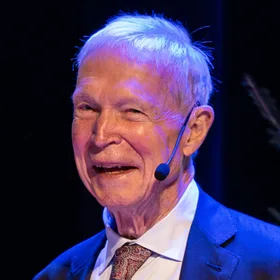
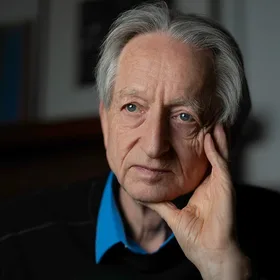
John J. Hopfield, Geoffrey Hinton · Shared by two people · 42 year wait
What they did
Hopfield built a network that can store patterns and bring them back, like a memory. Hinton built on it with the Boltzmann machine, which learns patterns from examples.
Why it matters
Their work led to today's AI. Hinton has also warned about the dangers of AI.
The official reason
"for foundational discoveries and inventions that enable machine learning with artificial neural networks"
The long road
- 1982Hopfield describes his memory network.
- 1985Hinton and colleagues describe the Boltzmann machine.
- 2012Hinton's students win a big image contest with a neural network.
- 2024Nobel Prize in Physics.
See the idea · 77-second film, with sound
The physics ideas that taught computers to learn.
- No recipe for a cat. Most programs follow a recipe, step by step. But no recipe can say what a cat looks like. Brains learn from examples. Their links grow stronger when used together.
- A web that remembers. Hopfield built a web of nodes, each linked to every other. Each node is a pixel, dark or light. He set the links so a saved picture has the lowest energy.
- Like a ball rolling downhill. Show it a smudged copy. One by one, nodes flip if that lowers the energy. Like a ball rolling into a valley, it ends on the saved picture.
- A machine that learns. Hinton and Terrence Sejnowski added hidden nodes and an equation from physicist Ludwig Boltzmann. Shown examples, their machine learned what they share. It could even make new ones.
- From 500 numbers to a trillion. Their work helped lay the base for today's AI. Hopfield's 1982 web had 30 nodes and fewer than 500 numbers to tune. Today's big language models can have over a trillion.
1 · The puzzle
No recipe for a cat.
Most programs follow a recipe, step by step. But no recipe can say what a cat looks like. Brains learn from examples. Their links grow stronger when used together.
A low-poly model made to show the idea. Hopfield's first network had 30 nodes; the other webs here are smaller, and real pictures need far more pixels.