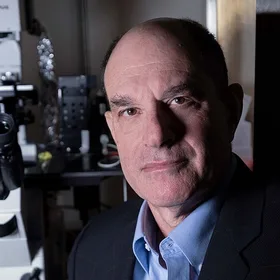
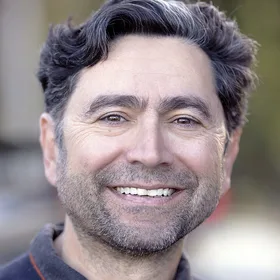
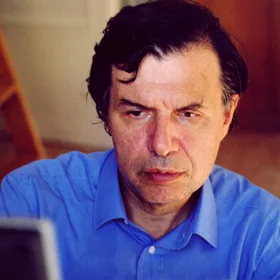
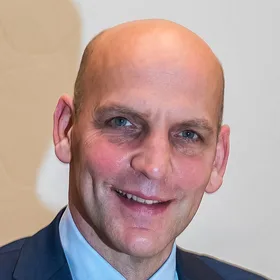
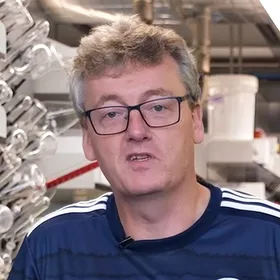
David Julius, Ardem Patapoutian · Shared by two people · 24 year wait
What they did
Julius used capsaicin, the hot part of chili peppers, to find the nerve sensor that feels heat. Patapoutian found Piezo1 and Piezo2, the sensors that feel pressure and touch.
Why it matters
These sensors help explain how we feel pain and know where our body is. Drug makers use them to look for new pain medicines.
The official reason
"for their discoveries of receptors for temperature and touch"
The long road
24years from Julius finding the heat sensor (1997) to the prize
1997Julius finds TRPV1, the sensor for heat and chili.
2002Julius and Patapoutian each find TRPM8, a sensor for cold.
2010Patapoutian finds the touch sensors Piezo1 and Piezo2.
How do nerves feel heat?Touch a hot pan and you pull back fast. But how does a nerve feel heat in the first place? No one knew.
Follow the chili.Chili burns because of capsaicin. Julius gave cells that ignore chili one gene each, from millions. One gene made them react.
Chili or heat opens it.It makes TRPV1, a tiny gate in the nerve. Capsaicin opens it, and so does heat above 40 °C. Then a signal fires.
Mint finds the cold gate.Mint feels cool because of menthol. Working apart, both men used it to find TRPM8, a gate that opens in the cold.
Poke, poke, silence.His cells sent a signal when poked. He switched off 72 genes, one by one. With one off, the poke went silent. He named it Piezo1, from the Greek for pressure.
How we sense the world.A second gate, Piezo2, lets us feel touch and sense where our body is. These gates guide the hunt for new pain treatments.
1 · The puzzle
How do nerves feel heat?
Touch a hot pan and you pull back fast. But how does a nerve feel heat in the first place? No one knew.
A white model made to show the idea. The real gates are single proteins, far too small to see, each search took years of work, and the genes, cells and sizes are sketches.
They made sense of complex systems, from the climate to messy materials.
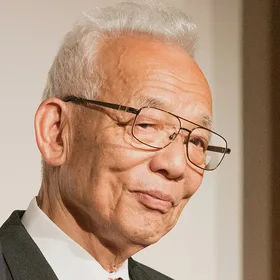
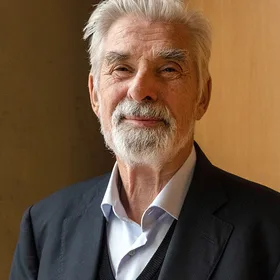
Syukuro Manabe, Klaus Hasselmann, Giorgio Parisi · Half shared by Manabe and Hasselmann, half to Parisi · 54 year wait
What they did
Manabe built early computer models of Earth's climate. They showed that more carbon dioxide warms the planet. Hasselmann linked weather to climate and found ways to spot humans' fingerprints on warming. Parisi found hidden order in messy, random systems.
Why it matters
Their work is the base of today's climate forecasts. Parisi's ideas are used in fields from physics to brain science and machine learning.
The official reason
"for the physical modelling of Earth’s climate, quantifying variability and reliably predicting global warming"(Syukuro Manabe and Klaus Hasselmann)
"for the discovery of the interplay of disorder and fluctuations in physical systems from atomic to planetary scales"(Giorgio Parisi)
The long road
54years from Manabe's climate model (1967) to the prize
1967Manabe's model shows more carbon dioxide warms the planet.
1976Hasselmann shows how fast weather adds up to slow climate change.
1979Parisi finds hidden order in disordered magnets.
Why we can trust climate models, and the order hidden in a mess.
A column of air.Manabe built a computer model of one column of air, 40 km tall. Sunlight comes in, heat goes out, warm air rises.
Double the carbon dioxide.He doubled the carbon dioxide. The ground warmed over 2 °C, and the top got colder. So the gas was the cause, not the sun.
Weather is the dog.Weather jumps about. Can a climate model still work? Hasselmann said yes. A dog darts about on a walk, but you can see where the walker goes.
Who left the prints?The sun, volcanoes and our gases each change the air in their own way. Hasselmann found how to tell them apart. The warming matches ours.
Magnets that can't agree.Spin glass is a metal full of tiny magnets. Some pairs want to match, others to clash, so one is always unhappy. Parisi found hidden order there.
From climate to flocks.Their work is the base of today's climate forecasts. Parisi's ideas are used in brain science, machine learning, and the study of starling flocks.
1 · Manabe, 1960s
A column of air.
Manabe built a computer model of one column of air, 40 km tall. Sunlight comes in, heat goes out, warm air rises.
A low-poly model made to show the idea. Real climate models split the whole planet into many columns, and the fingerprints are found with careful math, not by eye. Sizes and colours are a sketch.
A new, cleaner way to build mirror-image molecules.
Benjamin List, David W.C. MacMillan · Shared by two people · 21 year wait
What they did
Many molecules come in two mirror forms, like left and right hands. Often only one is useful. In 2000, List and MacMillan each showed that small, simple molecules can steer a reaction to make just one form.
Why it matters
Before, chemists mostly used metals or enzymes for this. The new way is cheaper and greener, and helps make medicines.
The official reason
"for the development of asymmetric organocatalysis"
The long road
21years from their first papers (2000) to the prize
2000List and MacMillan each publish the idea, on their own.
Like left and right hands.Many molecules come in two mirror forms, like your hands. One form of limonene smells of lemon. Its mirror twin smells of orange.
Only two kinds of helper.A catalyst speeds up a reaction and is not used up. Before 2000, chemists had two kinds: metals, often fussy about air and water, and huge enzymes.
One small amino acid.List asked: does it take a whole enzyme? He tried proline, one small amino acid. It worked at once, and made mostly one mirror form.
No metal needed.MacMillan left metals behind and designed small molecules instead. They built rings of carbon, over 90% in one mirror form. He named the idea organocatalysis.
Fewer steps, less waste.These helpers are cheap and green. Making strychnine took 29 steps in 1952. In 2011 it took 12, and was 7,000 times more efficient. Medicines are made this way too.
1 · Mirror twins
Like left and right hands.
Many molecules come in two mirror forms, like your hands. One form of limonene smells of lemon. Its mirror twin smells of orange.
A cartoon made to show the idea. The real molecules are far smaller and more complex, and the helper is not always this neat.
Stories of empire and of refugees caught between worlds.
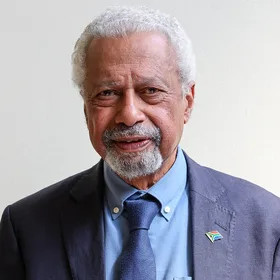
Abdulrazak Gurnah · One winner · 34 year wait
What they did
Gurnah was born in Zanzibar and came to England as a refugee. His novels follow people uprooted by colonial rule and by having to flee.
Why it matters
He gives voice to lives that history books often leave out.
The official reason
"for his uncompromising and compassionate penetration of the effects of colonialism and the fate of the refugee in the gulf between cultures and continents"
The long road
34years from his first novel (1987) to the prize
1968Arrives in England as a refugee from Zanzibar.
An island of many rulers.Gurnah was born in 1948 on Zanzibar, an island off East Africa. Portuguese, Arab, German and British powers all ruled it over the years.
Forced to flee at 18.Zanzibar won freedom from Britain in 1963. Then came a revolution, and people of Arab origin, like him, were attacked. At 18, he fled to England.
Writing in a new language.Swahili was his first language, but he writes in English. His ten novels run from Memory of Departure in 1987 to Afterlives in 2020.
A boy given away.In Paradise, young Yusuf is handed to a rich trader to pay his father's debt. He joins a caravan inland, as Germans take over East Africa.
Two men, one old feud.An old man from Zanzibar asks England for safety, with papers in his enemy's name. He meets the enemy's son. One remembers, one wants to forget.
Lives between two worlds.His people live between places, and their stories rarely end neatly. He shows an East Africa that many readers never knew.
1 · Zanzibar, 1948
An island of many rulers.
Gurnah was born in 1948 on Zanzibar, an island off East Africa. Portuguese, Arab, German and British powers all ruled it over the years.
A toy theater made to show the idea. The map is simple and the story scenes are our sketches, not from the books.
Two journalists who kept telling the truth under pressure.
Maria Ressa, Dmitry Muratov · Shared by two people · 28 year wait
What they did
Ressa co-founded Rappler, a news site that exposed abuse of power in the Philippines, including its deadly drug war. Muratov co-founded Novaya Gazeta, Russia's most independent newspaper. Six of its journalists have been killed.
Why it matters
A free press keeps power honest. The prize stood for every reporter working under threat.
The official reason
"for their efforts to safeguard freedom of expression, which is a precondition for democracy and lasting peace"
The long road
28years from Novaya Gazeta's founding (1993) to the prize
A news site in your pocket.Maria Ressa co-founded Rappler, a news site in the Philippines. It exposed the killings in President Duterte's war on drugs.
Tracking the lies.Rappler showed how fake accounts spread lies and attacked critics online. Ressa was arrested in 2019, but she kept reporting.
A paper that asks hard questions.Dmitry Muratov helped found Novaya Gazeta, Russia's most independent newspaper. It reports on corruption, election fraud, police violence and war.
Six reporters killed.Six of its journalists have been killed, among them Anna Politkovskaya, who wrote about the war in Chechnya. Muratov kept the paper independent.
He sold his medal.In 2022, Muratov sold his prize medal at auction for 103.5 million dollars. The money went to UNICEF, to help refugees from Ukraine.
Facts keep power honest.Free, fact-based news guards against lies, abuse of power and war propaganda. The prize stood for every reporter who works under threat.
1 · Ressa, 2012
A news site in your pocket.
Maria Ressa co-founded Rappler, a news site in the Philippines. It exposed the killings in President Duterte's war on drugs.
A paper pop-up book made to show the idea. The map dots and network are simple sketches, not real data.
David Card, Joshua D. Angrist, Guido W. Imbens · Half to Card, half shared by Angrist and Imbens · 27 year wait
What they did
Card used natural experiments, real events that work like a test, to study jobs and pay. One showed a higher minimum wage did not cut jobs at fast-food places. Angrist and Imbens showed what such events can and cannot prove.
Why it matters
Their methods changed how economists, and many others, learn from real-world data.
The official reason
"for his empirical contributions to labour economics"(David Card)
"for their methodological contributions to the analysis of causal relationships"(Joshua D. Angrist and Guido W. Imbens)
The long road
27years from the minimum wage study (1994) to the prize
1990Card studies what a wave of new workers from Cuba did to Miami's jobs.
1994Card and Alan Krueger's minimum wage study. Imbens and Angrist show what natural experiments can tell.
Cause, or just together?People with more school earn more. But is school the cause? Maybe talent drives both. We can't rerun a life to check.
A natural experiment.New Jersey raised its lowest legal wage from $4.25 to $5.05 an hour. Next door, in Pennsylvania, it stayed put. Real life had set up a test.
Jobs did not fall.Most economists expected job losses. Card and Alan Krueger counted fast-food workers on both sides. The higher wage did not cut jobs.
125,000 newcomers.In 1980, 125,000 people left Cuba for the US. Many settled in Miami, and its workforce grew by about 7%. Yet pay for local workers did not fall.
People choose for themselves.Chance can offer something, but people still choose. Angrist and Imbens showed what we can learn: the effect on those whose choice changed.
Real life as a lab.Natural experiments are everywhere: a new rule in one state, a birthday cut-off, a lottery. Their tools changed how we learn what works.
1 · The puzzle
Cause, or just together?
People with more school earn more. But is school the cause? Maybe talent drives both. We can't rerun a life to check.
A pencil sketch made to show the idea. The shops, people and chart lines are sketches, not the real data.