They found the virus behind a silent liver disease.
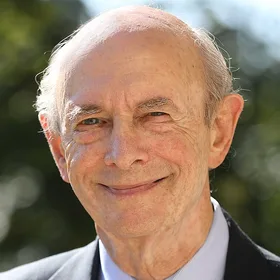
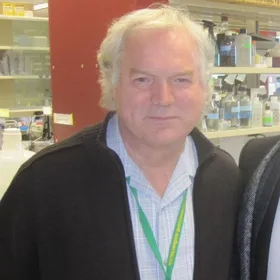
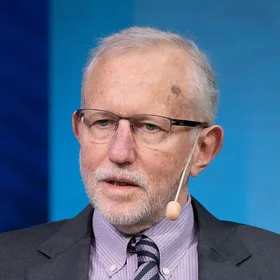
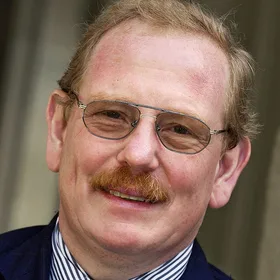
Harvey J. Alter, Michael Houghton, Charles M. Rice · Shared by three people · 31 year wait
What they did
In the 1970s, Alter showed that blood given in hospitals was spreading a new kind of hepatitis. In 1989 Houghton's team found the virus's genes: hepatitis C. Rice then proved that the virus alone causes the disease.
Why it matters
Hepatitis C can quietly wreck the liver for decades. Now donated blood is tested for it, and new pills cure most people who have it.
The official reason
"for the discovery of Hepatitis C virus"
The long road
31years from the virus being found (1989) to the prize
1975Alter's team shows a new kind of hepatitis spreads through blood.
1989Houghton's team finds the virus and names it hepatitis C.
1997Rice shows the virus alone can cause the disease.
A mystery in the blood.Alter studied patients who were given blood in hospital. The blood was tested for hepatitis A and B. Yet many patients still got a sick liver.
A germ no one could find.His team showed the patients' blood could pass the illness to chimpanzees. The germ acted like a virus. But it hid for more than ten years.
A needle in a haystack.Houghton's team took genes from infected blood and cut them into many small bits. They tested each bit with patients' blood. It holds antibodies, which grab the germ that made them sick.
One bit lit up.After a long search, one bit matched. It came from a new virus. They named it hepatitis C.
The final proof.Was this virus alone to blame? Rice built its genes in the lab. He fixed broken bits and added a missing end. Put in a chimp's liver, it made the same disease.
Safe blood, and a cure.Now donated blood is tested for hepatitis C. In many places, that ended hepatitis from blood. And new medicines can now cure it.
1 · Alter, 1975
A mystery in the blood.
Alter studied patients who were given blood in hospital. The blood was tested for hepatitis A and B. Yet many patients still got a sick liver.
A white model made to show the idea. Blue marks the germ and the sick spots; real blood is red. The real search tested a huge number of gene bits, far more than shown here.
Black holes are real, and a giant one sits at the middle of our galaxy.
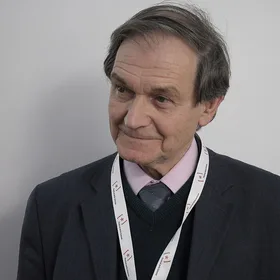
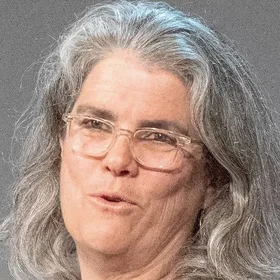
Roger Penrose, Reinhard Genzel, Andrea Ghez · Half to Penrose, half shared by Genzel and Ghez · 55 year wait
What they did
Penrose used math to show that black holes follow naturally from Einstein's theory of gravity. Genzel and Ghez each led a team that watched stars near the middle of the Milky Way for decades. The stars swing around something unseen, about four million times as heavy as the Sun.
Why it matters
It turned black holes from a strange idea into something we can measure. In 2022, astronomers took a picture of that same black hole.
The official reason
"for the discovery that black hole formation is a robust prediction of the general theory of relativity"(Roger Penrose)
"for the discovery of a supermassive compact object at the centre of our galaxy"(Reinhard Genzel and Andrea Ghez)
The long road
55years from Penrose's black hole paper (1965) to the prize
1965Penrose shows black holes follow from Einstein's theory.
1992Genzel's team starts tracking stars at the galaxy's center.
1995Ghez's team starts its own watch, from Hawaii.
2002Both teams follow a star almost all the way around the dark object.
Black holes are real, and one sits at our galaxy's heart.
Do black holes really form?Einstein's theory of gravity allowed black holes, but only for perfect, round stars. Real stars are lumpy. Not even Einstein thought black holes were real.
A trap with no way out.Penrose found a new math tool, the trapped surface. Once a falling star makes one, all light points inward. Nothing can stop the fall, even for a lumpy star.
Peek at the galaxy's middle.Dust hides the middle of the Milky Way. Genzel's team in Chile and Ghez's team in Hawaii used giant telescopes and infrared light to see through it. A bendy mirror took away the blur of the air.
Stars swing round nothing.For almost 30 years they tracked about thirty stars. One star, S2, goes all the way round in under 16 years. But at the middle, there is nothing to see.
Four million Suns, hidden.To swing stars that fast, the dark thing must weigh about four million Suns. Yet it fits in a space the size of our solar system. Only a black hole can do that.
Math and stars agree.Penrose's math said black holes must form. The stars showed a giant one in our own galaxy. Black holes went from a strange idea to something we can weigh.
1 · The puzzle
Do black holes really form?
Einstein's theory of gravity allowed black holes, but only for perfect, round stars. Real stars are lumpy. Not even Einstein thought black holes were real.
A low-poly model made to show the idea. Sizes and speeds are squeezed to fit, and the yearly dots for star S2 are drawn, not real data.
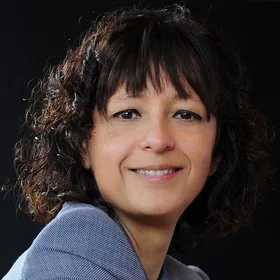
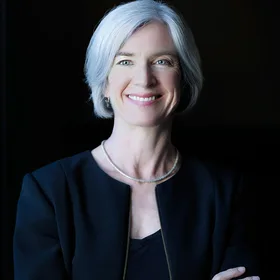
Emmanuelle Charpentier, Jennifer A. Doudna · Shared by two people · 8 year wait
What they did
Charpentier found a molecule that bacteria use to fight viruses. With Doudna, she turned that system, CRISPR-Cas9, into a tool. It can cut DNA at any spot you choose.
Why it matters
Labs everywhere now use it. In 2023, the first CRISPR medicine was approved, for sickle cell disease.
The official reason
"for the development of a method for genome editing"
The long road
8years from their CRISPR paper (2012) to the prize
2011Charpentier finds a key piece of the bacteria's virus-fighting system.
2012Charpentier and Doudna show Cas9 can cut DNA where they tell it to.
Bacteria keep wanted posters.When a virus attacks a bacterium, the bacterium can save a bit of the virus's genes in its own DNA. They sit in a list called CRISPR. Next time, it can spot that virus.
A new puzzle piece.Charpentier studied strep bacteria. She found an unknown small RNA, called tracrRNA. Part of it fits the CRISPR repeats, like two puzzle pieces.
Snip!With Doudna, she tested Cas9, the bacteria's cutting tool. With CRISPR RNA alone, nothing happened. Then they added tracrRNA, and the DNA was cut in two.
Scissors you can aim.They joined the two RNAs into one guide. Change the guide's code, and Cas9 cuts a new spot. They picked five spots in one gene. Every cut landed right.
Editing the code of life.Labs everywhere now use these scissors. They make crops that cope with drought. Doctors have tested them to treat blood diseases like sickle cell.
1 · Bacteria fight back
Bacteria keep wanted posters.
When a virus attacks a bacterium, the bacterium can save a bit of the virus's genes in its own DNA. They sit in a list called CRISPR. Next time, it can spot that virus.
A cartoon made to show the idea. Real DNA, RNA and Cas9 are far too small to see, and their shapes are simplified here.
A poet of few words.Louise Glück was an American poet. Her first book came out in 1968. Her poems are short and clear, with no fancy frills. By 2020 she had written twelve books of them.
Family, told plainly.After her father died, she wrote Ararat. It looks hard at a family's pain. She said these poems taught her to use ordinary, everyday words.
A garden that talks.In The Wild Iris, garden flowers speak to a gardener and to a god. In one poem, a snowdrop wakes after winter. The book won the Pulitzer Prize.
Old myths, new voices.She often spoke through Greek myths. Averno retells the story of Persephone. She is taken down to the land of the dead, and spring comes back when she returns.
One life, for everyone.The Nobel judges praised her voice and its stern beauty. Her poems take one person's life and make it feel like everyone's.
1 · Firstborn, 1968
A poet of few words.
Louise Glück was an American poet. Her first book came out in 1968. Her poems are short and clear, with no fancy frills. By 2020 she had written twelve books of them.
A toy theater made to show the idea. The books and scenes are sketches of what the poems are about, not her actual pages.
The UN's food agency, for fighting hunger in places at war.
World Food Programme · One winner · 59 year wait
What they did
The World Food Programme brings food to people hit by war, disaster and famine. In 2019 it helped close to 100 million people in 88 countries.
Why it matters
Hunger and war feed each other. The prize also warned that the pandemic was making hunger worse.
The official reason
"for its efforts to combat hunger, for its contribution to bettering conditions for peace in conflict-affected areas and for acting as a driving force in efforts to prevent the use of hunger as a weapon of war and conflict"
The long road
59years from its founding (1961) to the prize
1961The United Nations sets up the World Food Programme.
2019Helps close to 100 million people in 88 countries.
The world's biggest food helper.The United Nations set up the World Food Programme in 1961. It is the largest aid group fighting hunger. It moves food by plane, truck and ship to people in need.
Close to 100 million people.In 2019, it helped close to 100 million people in 88 countries. All of them faced severe hunger.
War and hunger feed each other.War can cause hunger. Hunger can make old fights flare up into violence. The prize said that food aid can help bring calm and a better chance of peace.
Hunger must not be a weapon.WFP helped push the UN Security Council to act. All its members voted for Resolution 2417. For the first time it linked war and hunger, and condemned starving people as a way to fight.
Food against chaos.In 2020 the pandemic made hunger much worse. WFP put it this way: "Until the day we have a medical vaccine, food is the best vaccine against chaos."
1 · Since 1961
The world's biggest food helper.
The United Nations set up the World Food Programme in 1961. It is the largest aid group fighting hunger. It moves food by plane, truck and ship to people in need.
A paper pop-up book made to show the idea. The red spots on the globe mark hunger, not exact places on a map.
They made auctions work better for things that are hard to sell.
Paul R. Milgrom, Robert B. Wilson · Shared by two people · 26 year wait
What they did
Wilson showed why bidders bid low when they fear paying too much. Milgrom, his student, built on that. Together they designed new kinds of auctions, like the ones used to sell radio waves to phone companies.
Why it matters
Governments have used their designs to sell airwaves for billions of dollars, and to get them to the people who will use them best.
The official reason
"for improvements to auction theory and inventions of new auction formats"
The long road
26years from the first US airwaves auction (1994) to the prize
1969Wilson publishes his first model of bidding when no one knows an item's true value.
1982Milgrom and Robert Weber publish a big step in auction theory.
1994The US runs its first airwaves auction, built on their design.
Highest bid wins.In an auction, buyers bid and the top bid wins. Auctions sell art and houses. They also sell electricity, and the radio waves our phones use.
The winner's curse.Say a raw diamond is worth the same to every dealer, but no one knows how much. Each one guesses. The dealer who guessed too high wins, and loses money.
Bid below your guess.Wilson worked out the best way to bid when the worth is unsure. Smart bidders bid under their guess. The more unsure they are, the lower they go.
Watch who quits.Milgrom showed why a price that climbs step by step helps. Each time someone drops out, the rest learn what that bidder thought. They fear the curse less, so prices end up higher.
Selling the airwaves.Phone companies needed radio waves in many regions. Milgrom and Wilson helped invent an auction that sells them all at once, in rounds. The first sold 10 licences in 47 rounds, for 617 million dollars.
Billions, raised fairly.Many countries copied it. From 1994 to 2014, US auctions like it raised more than 120 billion dollars. Before, the airwaves were given away almost for free.
1 · Auctions
Highest bid wins.
In an auction, buyers bid and the top bid wins. Auctions sell art and houses. They also sell electricity, and the radio waves our phones use.
A pencil sketch made to show the idea. The guesses, bids and quit prices are made up. The 10 licences, 47 rounds, 617 million dollars and 120 billion dollars are real.