Physics 2020 · Announced Oct 6
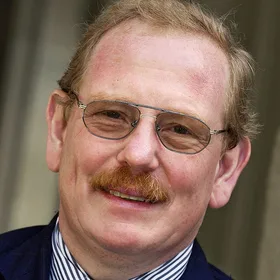
Reinhard Genzel
An astronomer who tracked the stars circling our galaxy's black hole.
Born 1952 · Germany · Max Planck Institute for Extraterrestrial Physics and UC Berkeley
55 yrs
The wait, from Penrose's black hole paper (1965) to the prize
68
Age when the prize was announced
3
People sharing this prize
Oct 6
Announced in 2020
Their part in the prize
Penrose used math to show that black holes follow naturally from Einstein's theory of gravity. Genzel and Ghez each led a team that watched stars near the middle of the Milky Way for decades. The stars swing around something unseen, about four million times as heavy as the Sun.
Why it matters
It turned black holes from a strange idea into something we can measure. In 2022, astronomers took a picture of that same black hole.
The road to the prize
- 1965Penrose shows black holes follow from Einstein's theory.
- 1992Genzel's team starts tracking stars at the galaxy's center.
- 1995Ghez's team starts its own watch, from Hawaii.
- 2002Both teams follow a star almost all the way around the dark object.
- 2020Nobel Prize in Physics.
Shared with
The official reason for this part of the prize: "for the discovery of a supermassive compact object at the centre of our galaxy"